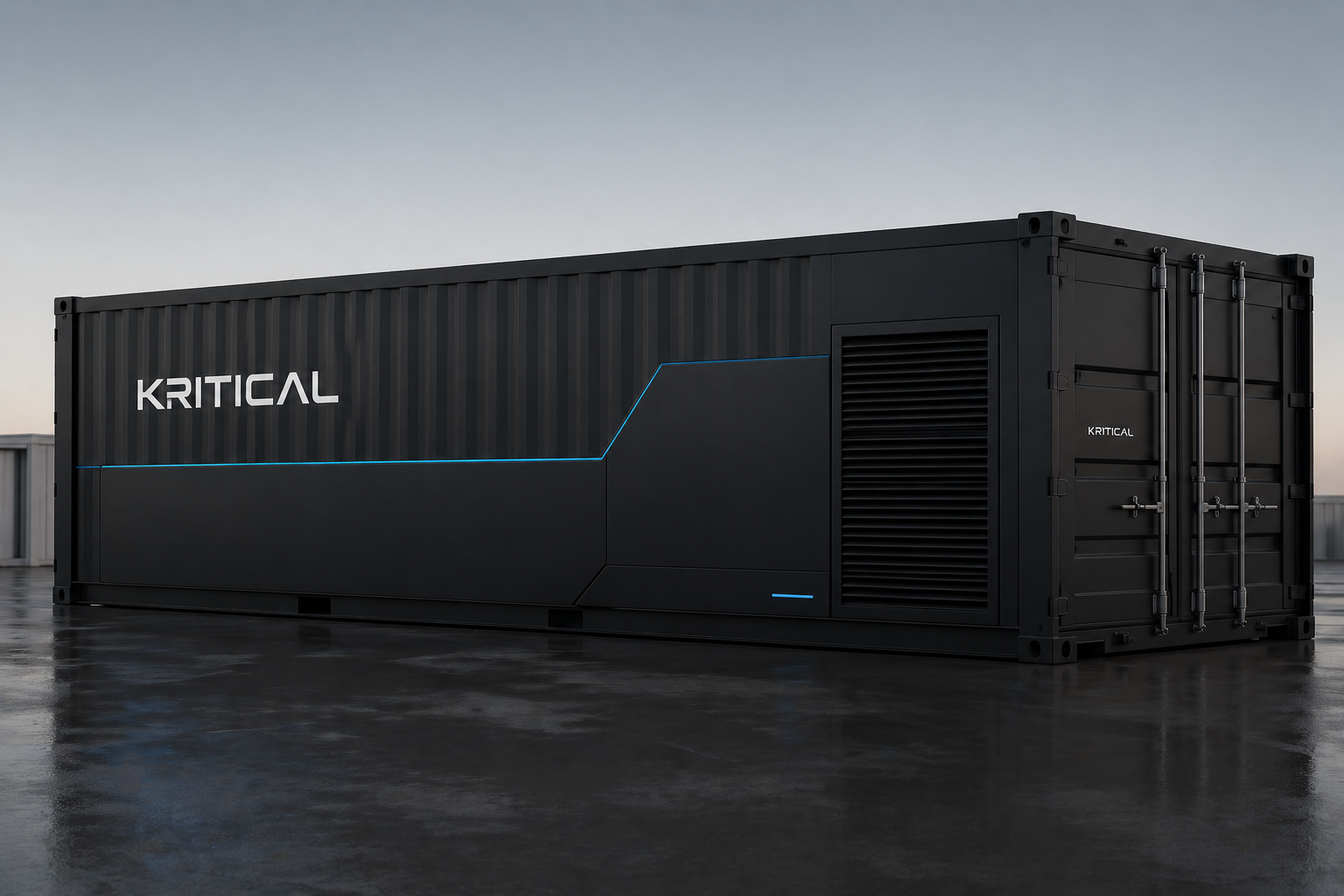
K-1 Containerized Absorption Chiller
System Initialize // KRITICAL // LONG BEACH, CA

Waste heat is
compute potential.

Containerized 5 MW absorption chillers for AI data centers. Driven entirely by turbine exhaust heat — zero electrical input — so 100% of generated power reaches compute.
Request Briefing
LAT: 33.7701° N
LNG: 118.1937° W
STATUS: SECURE
MODEL K-1
CAP 5 MW COOLING
FOOTPRINT 40FT ISO
ELEC. INPUT 0 kW
01. Crisis // SECTION 01

AI is eating electricity. Cooling is eating the rest.

Hyperscalers have moved to on-site gas turbine and fuel-cell generation to keep pace with compute demand. But compression-based chillers still consume up to 20% of every watt generated — power that should be reaching GPUs, not heat exchangers.
At gigawatt scale, this inefficiency compounds into billions in stranded energy — permanently baked into every facility built with the wrong thermal architecture.
20%
of generated power
wasted on cooling
200 MW
stranded per gigawatt
never reaches a single GPU
~1.0
target PUE
approaching unity
02. Insight // THESIS

Turbine exhaust is wasted energy. Absorption chillers convert it into cooling at zero electrical cost.

PROVEN TECHNOLOGY

No new chemistry required

The lithium bromide / water absorption cycle is commercially available today. We are not inventing physics — we are productizing a 60-year-old industrial process for the data-center deployment model.

ZERO ELECTRICAL INPUT

100% of power → compute

Heat from turbine exhaust drives the entire cooling cycle. There is no compressor. There is no parasitic electrical load. Every watt of generated power is allocated to GPUs.

UNTAPPED MARKET

First mover, no startup competitors

Legacy industrial players build custom one-offs. No startup has productized absorption cooling for the rapid-deployment hyperscaler model. We are the first.

03. Platform // SECTION 03
KRITICAL K-1

Containerized 5 MW absorption chiller skid.

Engineered for the data center rapid-deployment model. Drop-in. Scalable. No compressor. The K-1 captures turbine exhaust gas and converts it directly into chilled water for chip cooling — without consuming additional electricity.
  • Driven entirely by turbine exhaust heat
  • Zero electrical input required
  • 100% of facility power allocated to compute
  • Standard ISO containerized format — installs fast
  • 20+ year service life with minimal maintenance
  • LiBr / water working fluid — exempt from EPA refrigerant rules
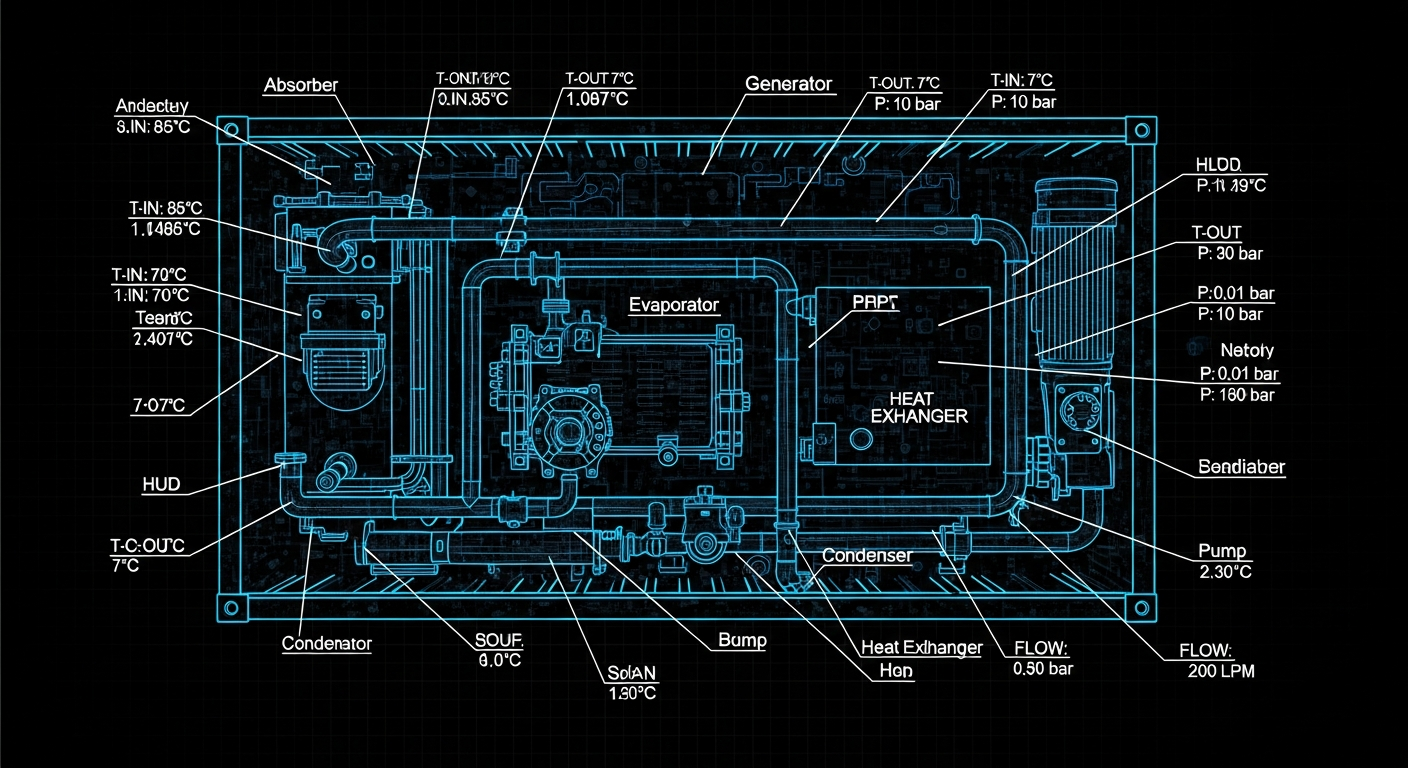
K-1 internal schematic
FIG 1. K-1 INTERNAL
LiBr ABSORPTION CYCLE // 5 MW THERMAL
Cooling Capacity
5 MW
Electrical Input
0 kW
Form Factor
40 FT ISO
Service Life
20+ YR
04. Cycle // SECTION 04

Four stages. One closed loop. No moving compressor.

STAGE 01

Generator

Turbine exhaust heat boils the lithium bromide / water solution, releasing high-pressure water vapor. No compressor. No electrical work.

STAGE 02

Condenser

Vapor is condensed back to liquid against the dry-cooler loop, recovering the working fluid for the low-pressure stage.

STAGE 03

Evaporator

Liquid water flash-boils into a low-pressure chamber, producing a 20–30°C delta. This is the chilled-water output that returns to the data hall.

STAGE 04

Absorber

Vapor is reabsorbed into the diluted LiBr solution. The exothermic reaction is rejected by the dry cooler, closing the cycle.

// Working fluid: LiBr / H₂O · Heat source: turbine exhaust (low-grade) · Output: chilled water to data hall · Reject loop: dry cooler
05. Advantage // SECTION 05

The incumbents build custom industrial projects. We ship a product.

INCUMBENTS // Thermax · Johnson Controls · World Energy
KRITICAL
01
Large, custom industrial projects
Productized 5 MW containerized skid
02
12–24 month lead times
Fast-deploy, repeatable units
03
Not built for data center deployment
Purpose-built for hyperscaler ops
04
No standard, repeatable architecture
Lot-production line, designed for scale
06. Roadmap // SECTION 06
PHASE 01 6 MONTHS

Validate

$150K

1 kW bench-test unit. Validate thermodynamic models. Secure LOIs from operators.

PHASE 02 12 MONTHS

First Unit

$10M

Production 5 MW skid. Build supply chain. Commission Unit 1 with launch customer.

PHASE 03 5 MONTHS

Factory

$10M

KRITICAL MAX factory standup in Long Beach. Begin lot production of K-1 skids.

PHASE 04 BY 2029

Scale

1 GW DEPLOYED

Aggressive lot production. Channel partnerships with infra integrators. Multi-GW pipeline.

07. Market // SECTION 07

Multi-gigawatt data centers are no longer science fiction.

At $1.25M per MW of cooling capacity, a single 1 GW facility represents $1.25B in revenue potential. With no startup competitor operating at this intersection, the market is wide open.
We intend to own it.
$1.25B
revenue potential per
1 GW data center deployment
156 GW
estimated global data center
capacity by 2030
08. Team // SECTION 08
Aditya Khanna Founder & CEO

Mechanical engineer. Designed transcritical CO₂ chillers for hyperscalers at KARMAN Industries. Hypersonic propulsion systems at Specter Aerospace. Domain expertise in exactly this problem.

Alex Frank Advisor

CEO @ Lifted Energy. Combustion & Chemical Engineering Ph.D., UC Berkeley.

Arun Chundru Advisor

CTO @ Specter Aerospace.

Danny Seth Advisor

CEO @ Funex. Ex-Goldman Sachs / PIMCO. MBA, Harvard.

// INITIALIZE DEPLOYMENT

Schedule a deployment briefing.

We work directly with hyperscaler procurement and data center facility operators. Reach out and our engineering team will respond within 48 hours.